25.03 Selection of Members to the State of Georgia SWAT Team
DISTRIBUTION - ALL EMPLOYEES
DATE REVISED - 4/21/2015
25.03.1 Purpose
For the State of Georgia Special Weapons and Tactics (SWAT) Team to perform their function, well-disciplined, and highly motivated individuals are required. The purpose of this policy is to establish uniform guidelines for the selection of members to the SWAT Team.
25.03.2 Policy
It is the policy of the Georgia State Patrol to provide the best available personnel to the SWAT Team in an effort to provide the highest level of service to the Department, other law enforcement agencies, and the citizens of Georgia. Members of the Georgia State Patrol staff the element members, Tactical and SWAT Commander positions.
25.03.3 Procedures
A. Vacancies
The Commanding Officer shall advertise vacancies within the SWAT Team in conjunction with Human Resources by email, notifying potential candidates of the vacancy, the application procedure, and the minimum requirements.
B. Application Procedure
Following the receipt of applications, a four-stage selection process commences. Each stage is progressive, meaning that the applicant shall pass each stage before progressing to the next stage. Only one attempt is permitted at each stage of testing. The stages are:
1. Firearms skills assessment. (See Exhibit #25.03-1)
2. Physical skills assessment comprised of:
a. Physical fitness assessment. (See Exhibit #25.03-2)
b. Obstacle course - The applicant shall be videotaped during this component. (See Exhibit #25.03-3)
c. Swim test. (See Exhibit #25.03-4)
3. Review of the application by the SWAT Commander or their designee.
4. Oral interview before the selection panel. The panel shall be comprised of the SWAT Commander, the Tactical Team Commander, Element Leaders, a member of Human Resources and an outside Tactical Commander, which shall select the applicants with approval of the Commissioner of the Department of Public Safety.
5. The applicant shall successfully complete a Department approved 80 hour SWAT training course to become a member of the SWAT team. A certificate of completion shall be placed in the member’s 201 File.
C. Minimum Requirements
1. The applicant shall have attained the rank of Trooper through Sergeant First Class within the Department of Public Safety. Element Leaders should be of Sergeant First Class (SFC) rank, however, if no qualified SFC applies, the position may be filled by a Sergeant or lower ranking member.
2. Applicant shall not be a member of both the SWAT Team and another specialized team including the Crisis Negotiation Team (CNT), Honor Guard, and/or the Specialized Collision Reconstruction Team (SCRT).
3. The applicant shall not have received any adverse action in the two years prior to application.
4. The applicant must be a dedicated, disciplined and a team player both on and off duty.
5. The applicant shall have at least ”met” expectation on their previous two annual performance management forms (PMF).
6. The applicant (for part time positions) shall volunteer to perform duty in the SWAT Team in addition to their normal duties.
D. Selection of SWAT Commander, Tactical Team Commander, and Assistant Tactical Team Commander
The selection of the SWAT and Tactical Team Commanders are critical to the successful operation of the SWAT Team. Upon recommendation of the Commanding Officer, the Commissioner of the Department of Public Safety appoints the positions of SWAT Commander and Tactical Team Commander. The Tactical Team Commander recommends the Assistant Tactical Team Commander to the Commanding Officer, from candidates that have successfully completed the Department’s promotions procedures found in the Promotions and Transfers Policy #24.01.
Because of the nature of their assignments specific criteria are required to be met for these
positions as follows:
1. The applicant shall have at least ”met” expectation on their previous two annual performance appraisals;
2. The applicant shall not have received any adverse actions in the two years prior to application;
3. The applicant shall have at least one-year experience in SWAT Tactics;
4. The applicant shall have at least 80 hours of tactical supervision training;
5. For the SWAT Commander position, the applicant shall hold the rank of Captain or be eligible for promotion to the rank of Captain;
6. For the Tactical Team Commander position, the applicant shall hold the rank of Lieutenant or be eligible for promotion to the rank of Lieutenant, and shall possess at least two years experience with tactical application;
7. For the Assistant Tactical Team Commander position, the applicant shall hold the rank of Sergeant First Class or be eligible for promotion to the rank of Sergeant First Class;
8. For the Equipment and Logistics Officer position, the applicant shall hold the rank of Sergeant or be eligible for promotion to the rank of Sergeant;
9. For the Training Cadre Officer position, the applicant shall hold the rank of Corporal or be eligible for promotion to the rank of Corporal, and
10. All applicants, with the exception of the SWAT Commander, shall successfully complete the firearms and physical skills assessments as described for team members above.
25.03-1 Firearms Skills Assessment
DATE REVISED - 4/21/2015
A. Purpose
This course shall be used to test the practical marksmanship skills of personnel who have applied for positions in the team. It is recognized that the applicants have not received specialized training in the use of reserve weapons typically used by the team. For this reason, the applicant’s issued handgun, with which they should be thoroughly familiar, shall be used to test practical marksmanship skills.
B. Objective
1. The objective is to determine if the applicant has mastered the fundamentals of practical marksmanship. It is upon this foundation that advanced skills will be developed within each team member.
2. It is essential for all selected personnel to have a mastery of the basic skills prior to selection in order to be prepared for advanced level training, which shall commence immediately upon selection to the team.
C. Required Standard
The applicant shall fire the course three times. The first two are for familiarization, with the final attempt being scored to determine qualification.
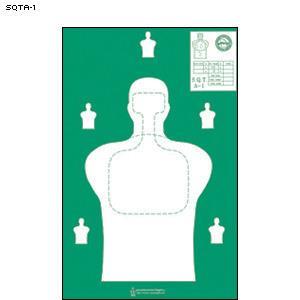
The GPA – Standard Qualification Target and scoring system shall be used. One score of 80% or better is required to pass.
1. The Course
The course includes realistic time limits, distances, and drills. It is designed to simulate 30 separate gunfights. These occur at seven to 25 yards, require from one to four rounds to solve, and last for two to eight seconds each.
All stages begin with the weapon holstered. The shooter’s hand must be off the weapon and in an interview position.
Firing position is “free-style” for all stages (standing, kneeling, or prone). Any of these positions can be used for any stage at the discretion of the shooter.
a. Stage #1 - Total of five rounds from seven yards – one round in two seconds. Repeat five times.
b. Stage #2 - Total of eight rounds from seven yards – two rounds in 2.5 seconds. Repeat four times.
c. Stage #3 - Total of six rounds from seven yards – two rounds to the body and one round to the head in five seconds. Repeat two times.
d. Stage #4 - Total of six rounds from ten yards – two rounds in three seconds. Repeat three times.
e. Stage #5 - Total of eight rounds form ten yards – two rounds, reload, and fire two rounds in eight seconds. Repeat two times.
f. Stage #6 - Total of three rounds from 15 yards – one round in three seconds. Repeat three times.
g. Stage #7 – Total of three rounds from 25 yards – one round in four seconds. Repeat three times.
h. Stage #8 - Total of six rounds from 25 yards – two rounds in five seconds. Repeat three times.
2. Scoring
The raw score shall be divided by 225. 80% of the rounds are fired from the 15-yard line or closer. A total of 45 rounds shall be fired for the course.
3. Target
The illustration shown below indicates the scoring regions of target.
25.03-2 Physical Fitness Assessment
DATE REVISED - 4/21/2015
A. Purpose
The purpose of the assessment is to determine the status and fitness level of the SWAT team.
1. The assessment shall consist of a battery of five evaluations as follows:
a. 1.5 Mile Run - The 1.5-mile run shall measure cardio respiratory fitness. The objective is to run the 1.5-mile distance as fast as possible. The running area shall be substantially level. On a standard 440-yard track six laps should be completed. Participants may be informed of their lap times. Final times shall be called out and recorded. Upon completion the participants shall be required to walk a cool down lap.
b. Push-ups - The push-up evaluation measures muscular endurance of the upper body. Hands shall be placed slightly wider than shoulders with fingers pointing forward. A three-inch sponge shall be placed under the sternum. Starting from the up position (elbows fully extended) the subject shall keep the back straight at all times and lower the body to the floor until the chest touches the sponge, the subject then returns to the up position. This shall be one repetition. Any resting shall be done in the up position. The total number of correct push-ups shall be recorded as the score.
c. One-Minute Sit-ups - The one-minute sit-up evaluation measures abdominal muscular endurance. The subject starts by lying on their back, knees bent, heels flat on the floor, with arms crossed and fingertips touching the shoulder area. A partner shall be utilized to hold the feet down firmly. The subject shall then bend upward and touch the elbows to the knees in the up position. This is one repetition. The total number of correct sit-ups in one minute shall be recorded as the score.
d. One Rep Max Bench Press - The one rep max bench press measures absolute strength. Absolute strength is defined as the amount of tension a muscle can exhibit in one maximal contraction. Using free weights and a standard bench press, start with approx 2/3 of the subject’s body weight for a male subject and only the bar (45lbs) for a female subject. Two spotters shall be used, one on each end of the bar. The spotters should lower the bar to the subject’s chest. The spotters shall release the bar and the subject shall press to a full extension while exhaling. Repeat the above until a one-rep max is reached. This should take approximately five to six trials. Once the maximum weight in pounds is determined, divide the pounds by the body weight to obtain ratio.
e. Vertical Jump Test - This is a measure of jumping or explosive power. It is an important area for pursuit tasks that require jumping and vaulting. Using a yardstick taped to a smooth wall, use chalk dust to mark the wall so that maximum height is easily determined. The subject begins with one side toward the wall and reaches up as high as possible to mark their standard reach. The subject then jumps as high as possible and marks the spot on the chalked wall above their standard reach mark. Prior to jump, one foot must remain stationary on the floor. Score is the total inches between standard reach and maximum height achieved to the nearest quarter inch. The final score shall be the best of three tries.
2. Physical Fitness Scoring Procedure
a. The physical fitness test for the SWAT team is broken down into five events. Each event has a minimum standard. If this standard is not met the new SWAT candidate shall go no further in being evaluated.
b. Each event shall be completed and shall carry from 15 to 25 points in two point increments based upon individual performance in that event (Refer to male or female standards below). The total points obtained from the five events shall be the subject’s final score.
c. A total of 100 points shall be reached in order to qualify for the team. If, however, a total of 115 points is achieved, the subject, if selected, or an existing team member shall be given a special ribbon to be worn on the uniform to signify this achievement. If a perfect score of 125 points is achieved, the subject if selected for the team or an existing member shall be awarded a special ribbon to be worn on the uniform to signify this achievement.
1) Description of Ribbons
a) A score of 100 points = a plain black ribbon signifying a current SWAT member.
b) A score of 115-124 points = a black ribbon with a vertical silver bar.
c) A perfect score of 125 points = a black ribbon with a vertical gold bar.
2) The ribbon shall be worn in accordance with the Department Awards Program Policy #20.01.
25.03-3 Obstacle Course
DATE REVISED - 4/21/2015
A. Purpose
The purpose of the obstacle course is to determine the physical capability of the member in performing tasks necessary for the accomplishment of SWAT missions.
B. Requirements
1. The course shall be run in a tactical vest provided by the training cadre. The participants shall wear their helmets and gloves. All obstacles shall be properly negotiated. Team medics shall be on hand in case of emergency.
2. Participants shall be required to perform a certain common series of physical tasks while wearing designated equipment to simulate an actual tactical operation.
C. Course
The total distance of the course is 150 yards and shall be completed in less than five minutes. The participant shall sprint between steps 1 through 12.
1. Hurdles – The participant negotiates three hurdles (5, 6, and 7 foot).
2. Wall climb - The participant climbs over a 10-foot wooden wall with the use of a rope.
3. Pole ladder - The participant climbs over a 20-foot pole ladder.
4. Hurdles – The participant negotiates three hurdles (all 4 foot).
5. Tires – The participant negotiates a series of tires laid on the ground.
6. Low crawl – The participant crawls under a chain link mesh that is 2 feet above the ground.
7. Serpentine – The participant weaves through a series of posts.
8. Balance beam - The participant traverses a beam 30 feet long.
9. Ladder climb - The participant climbs a 5-foot ladder.
10. Sprint – The participant sprints 50 yards.
11. Wall climb - The participant climbs over a 6-foot wall unaided.
12. Body drag - The participant drags 165 lb. dummy 20 yards.
25.03-4 Swim Test
DATE REVISED - 4/21/2015
The swim test is comprised of the following exercises:
A. Demonstrate the ability to swim 50 yards without any type of flotation device without touching bottom.
B. Demonstrate the ability to tread water for five minutes.