Chapter 25 - Special Units & Support Services
25.01 Aviation Support
DISTRIBUTION - ALL EMPLOYEES
DATE REVISED - 9/13/2007
25.01.1 Purpose
The purpose of this policy is to establish guidelines for requesting and utilizing services of the Georgia State Patrol (GSP) Aviation Unit. The Aviation Unit maintains a separate operations manual for routine daily operations of the unit, which shall comply with and be subordinate to this policy. The operations manual will be made available on request for official use.
25.01.2 Policy
It is the policy of the Department of Public Safety that all Department aircraft shall be used only for lawful and authorized purposes. The GSP Aviation Unit provides air support to state, local and federal agencies. The Unit’s first priority in missions is support to those missions that may involve life or death situations or high risk to public safety. The unit’s first priority to agencies is support to the GSP and its statutory mission, including security protection for the Governor, Lieutenant Governor, Speaker of the House and their immediate families.
25.01.3 Procedures
A. Scheduling Priorities
Priority for use will be given in the following order:
1. For the preservation of life or prevention of an imminent threat of harm to the public or public safety;
2. For the prevention of large-scale destruction of property subject to imminent threat or attack;
3. Governor;
4. Lieutenant Governor and Speaker of the House;
5. Members of the General Assembly, and
6. All others on a first come first served basis or as ordered by the Commissioner.
B. Authorized Pilots
State Aircraft assigned to the Department of Public Safety shall be piloted only by:
1. Employees of the Department who have been approved by the Director of Aviation to pilot the particular type and model of aircraft, based on required licensing and training.
2. Other persons for a particular flight who hold the appropriate current license for the type and model of aircraft who have been approved by the Director of Aviation for that particular flight. The Director of Aviation shall retain a record of the approval with such record identifying the pilot, his license number, the description of the flight and the reason for the approval.
3. In a life-threatening emergency, any person, provided that there is no one otherwise authorized by this policy available.
C. Authorized Passengers
Use of State Aircraft shall be limited to the persons listed below.
1. Employees of State Government, Federal Government or local government when in the performance of State or intergovernmental functions or when providing support to other Governmental agencies.
2. Law Enforcement, Prosecutors, Judges or Military Personnel while performing official duties.
3. Any non-employees from whose carriage the state derives some benefit. This category would include:
a. Industry promotion passengers – persons accompanying the Governor, Lt. Governor or Commissioner of Industry, Trade and Tourism or their designee for purposes of locating potential locations for new industry.
b. Public Information Passengers – persons being carried to educate and assist in providing public information on matters of concern to the Department or to the State.
c. Contractors – Private Persons while performing functions for State agencies under contract or agreement.
d. Such other persons as approved in writing by the Commissioner, the Deputy Commissioner, the Commanding Officer or the Director of Aviation with a written explanation as to the tangible benefit received by the carriage.
e. When the Pilot or the Director of Aviation determines that carriage of a person not otherwise permitted by policy is required due to a life-threatening emergency or a serious medical emergency, such person may be carried. Within three calendar days, a written explanation as to the emergency situation shall be made to the Commissioner and attached to the Flight Report.
4. Members of the General Assembly.
5. Members of boards, agencies, commissions, and bureaus of the State of Georgia.
6. Other passengers meeting the qualifications set out in O.C.G.A. § 35-2-73 which includes providing transportation to the Governor, Lieutenant Governor, Speaker of the House and their immediate family members. For purposes of this policy, immediate family members mean those members of the official’s family who reside with that official as part of the household. Further, immediate family members are authorized to travel in Department aircraft in the following three circumstances:
a. When traveling with the protected official relative;
b. When traveling at the request of the protected official relative for State business, or
c. When, in accordance with the procedure set forth in subsection E, 7 of this section, it has been determined that security requirements dictate the use of Department aircraft to transport an immediate family member.
D. Out of State Travel
1. Travel to out-of-State destinations is prohibited unless there has been prior approval by the Commissioner or his designee.
2. For purposes of this provision, the Commissioner’s designee shall be the Deputy Commissioner or such other person who has received a written delegation of authority.
E. Flight Requests
1. Emergency Support to GSP
a. In an emergency, any member of the GSP may request air support from the Aviation Unit.
b. Except when the request is from a member above a post commander in the chain of command, the member wishing to request air support should first contact the NCO on call in the post territory where the request originates.
c. The NCO on call will make the decision as to whether to request air support.
d. Once approved by the NCO on call, the request may be made by the NCO on call or by the member originally seeking air support and should be made by the most expeditious means available, directly to the Aviation Unit.
e. The NCO on call will notify the Troop Officer on call.
f. If Aviation is unable to/or does not respond they shall inform the Post NCO at the time of the request.
2. Routine Support to GSP - Routine requests for support to the GSP should be made through the proper chain of command to the Troop Commander.
3. Emergency Support to other agencies
a. In an emergency, any member of another public safety agency may request air support directly from the GSP Aviation Unit.
b. The pilot responding to the request will notify the Post in whose territory the assistance will be provided. The person who receives the notification at the Post will be responsible for notifying the NCO on call. The NCO on call will
notify the Troop Officer on call.
4. Routine Support to other agencies
a. Routine requests from other agencies should be made to either the field hangar in the area where the request originates or to the Aviation Unit Headquarters.
b. The Pilot responding to the request will notify the Post in whose territory the assistance will be provided. The person who receives the notification at the Post will be responsible for notifying the NCO on call. The NCO on call will notify the Troop Officer on call.
5. Part-time aircrew support
a. In an emergency, the pilot responding to the call will notify the Tactical Flight Officer (TFO/FLIR operator) of the mission by the most expeditious means available.
b. Upon notification, the TFO will be considered detached to the Aviation Unit and will be under the direct supervision of the Aviation Unit Commander or their designee for the duration of the mission.
c. The pilot will notify the Post where the TFO is assigned and provide details of the mission available at that time.
d. The person who receives the notification at the Post will be responsible for notifying the NCO on call of the mission and the TFO’s deployment.
6. Transport of persons
a. The Department will accept requests for transportation from the Office of the Governor, Members of the General Assembly, and, where consistent with the public safety mission of the Department, those acting on the authority of
Chief Executive Officers, or their designee, of departments, agencies or authorities of the State of Georgia.
b. Department aircraft may only be used for conducting the business of the State of Georgia. Guidelines that govern this decision are based on the State deriving a benefit from the scheduled flight. Department aircraft may not be used for any flight or discrete leg of a flight that has only non-public (private or political) purposes. It is not a violation of this policy for a Department aircraft to be used for a flight to a destination where the official may participate in both a legitimate public purpose as well as either a private or political purpose. If there is a political purpose or function at a destination where there was also a public purpose or function, the official must reimburse the Department the costs of the use of the aircraft that is
apportioned to the political purpose. There is no reimbursement related to private functions at the same destination as a public function unless additional costs for the flight are accrued as a result of the official attending the private function, in which case the additional costs will be reimbursed to the department.
7. Transport for Executive Security Reasons
a. Anytime the Commissioner of Public Safety or his designee (i.e., for this purpose, Deputy Commissioner, Commanding Officer or such other person who has received a written delegation of authority) has determined that transportation in Department aircraft is necessary for executive security purposes, the flight is considered appropriate under this policy.
b. Such determination must be in writing and must be documented with the supporting reasons which indicate that transportation in a Department aircraft is preferred for security reasons over other transportation. When possible, the written determination should be prepared prior to the flight, but may, when required by circumstances, be prepared at a reasonable time subsequent to the flight. A copy of this determination will be filed in the Commissioner’s Office and in the office of the Commanding Officer.
F. Flight Report
1. Pilots shall complete a flight report for each flight by a state aircraft. The pilot will list all touchdowns with the times, locations and purpose of the landings. The state agency, board, commission, etc. and purpose of the flight must be shown unless disclosure would jeopardize the mission or compromise public safety measures.
2. The number of passengers must always be listed on the flight report. Unless disclosure would jeopardize the mission or compromise public safety measures, pilots shall ensure that the names of all passengers are included on the flight report except in the following situations:
a. At the discretion of the Governor or the Commissioner of Industry and Trade, the names and positions of officers or representatives of industry on industry seeking activities need not be recorded.
b. The Governor, at his sole discretion, may decline to list the names and positions of the passengers accompanying him on the flight.
c. The Commissioner or the Deputy Commissioner has approved or directed omission of the names of any passenger or passengers.
3. Additional information may be documented as specified in the Aviation Operations Manual.
25.02 Activation of the State of Georgia SWAT Team
DISTRIBUTION - ALL EMPLOYEES
DATE REVISED - 4/21/2015
25.02.1 Purpose
It is the purpose of this policy to establish uniform guidelines for the activation of the State of Georgia Special Weapons and Tactics (SWAT) Team. Appropriate procedures are required to be followed to ensure that the activation is in accordance with the mission of the SWAT Team.
25.02.2 Policy
It is the policy of the Georgia Department of Public Safety (DPS) that the activation of the SWAT Team takes precedence over all other assignments within the GSP. The DPS troopers assigned to the SWAT Team become subordinates to the Tactical Team Commander until the Tactical Team Commander determines that the activation is over.
25.02.3 Procedures
A. Operational Structure
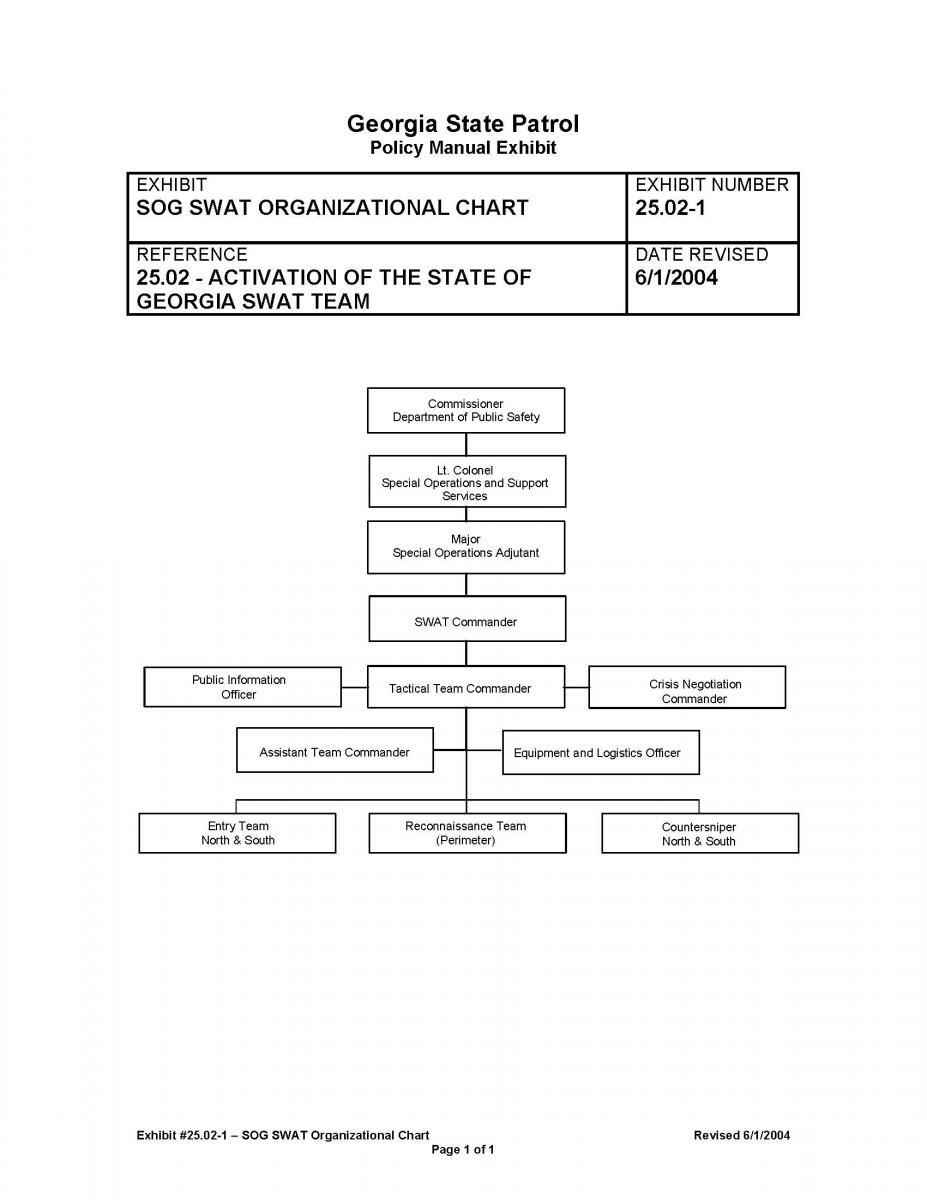
The team is comprised of a Tactical Team, a Crisis Negotiation Team (CNT), Support Personnel and Tactical Medics. The Organizational Chart of the SWAT Team is attached as Exhibit 25.02-1.
B. Authority to Activate SWAT Team
1. The SWAT Commander, or if unavailable, the Tactical Team Commander, or their designee has the authority to immediately activate the team for any critical incident within jurisdictional boundaries. They also have the authority to deny the activation of the team upon evaluating a request.
2. The SWAT Team is available, with the approval of the SWAT Commander, or if unavailable, the Tactical Team Commander, or their designee, to the DPS or any requesting law enforcement agency in the State of Georgia.
C. When Activation is Required
1. Units of the Department should request the assistance of the SWAT Team in planning and conducting operations in response to a critical incident. Critical incidents include:
a. Hostage Situations - The holding of any person(s) against their will by an armed or potentially armed suspect.
b. Barricaded Situations - The standoff created by an armed or potentially armed suspect in any location, whether fortified or not, who is refusing to comply with police demands for surrender.
c. Sniper Situations - The firing upon citizens and or police by an armed suspect, whether stationary or mobile.
d. Apprehension - The arrest or apprehension of armed or potentially armed suspect(s) where there is the likelihood of armed resistance.
e. Personal Protection - The security of special persons, such as VIP’s, witnesses, or suspects, based on threat or potential threat to the well being of those persons.
f. Active Shooter Situations - One or more subjects who participate in a random or systematic shooting spree, demonstrating their intent to continuously harm others. Their overriding objective appears to be that of mass murder, rather than other criminal conduct such as robbery, hostage taking, etc.
g. Special Assignments - Any assignment, approved by the Commissioner of the Department of Public Safety or his designee, based upon the threat level or the need for special expertise.
2. Warrants – Units of the Department:
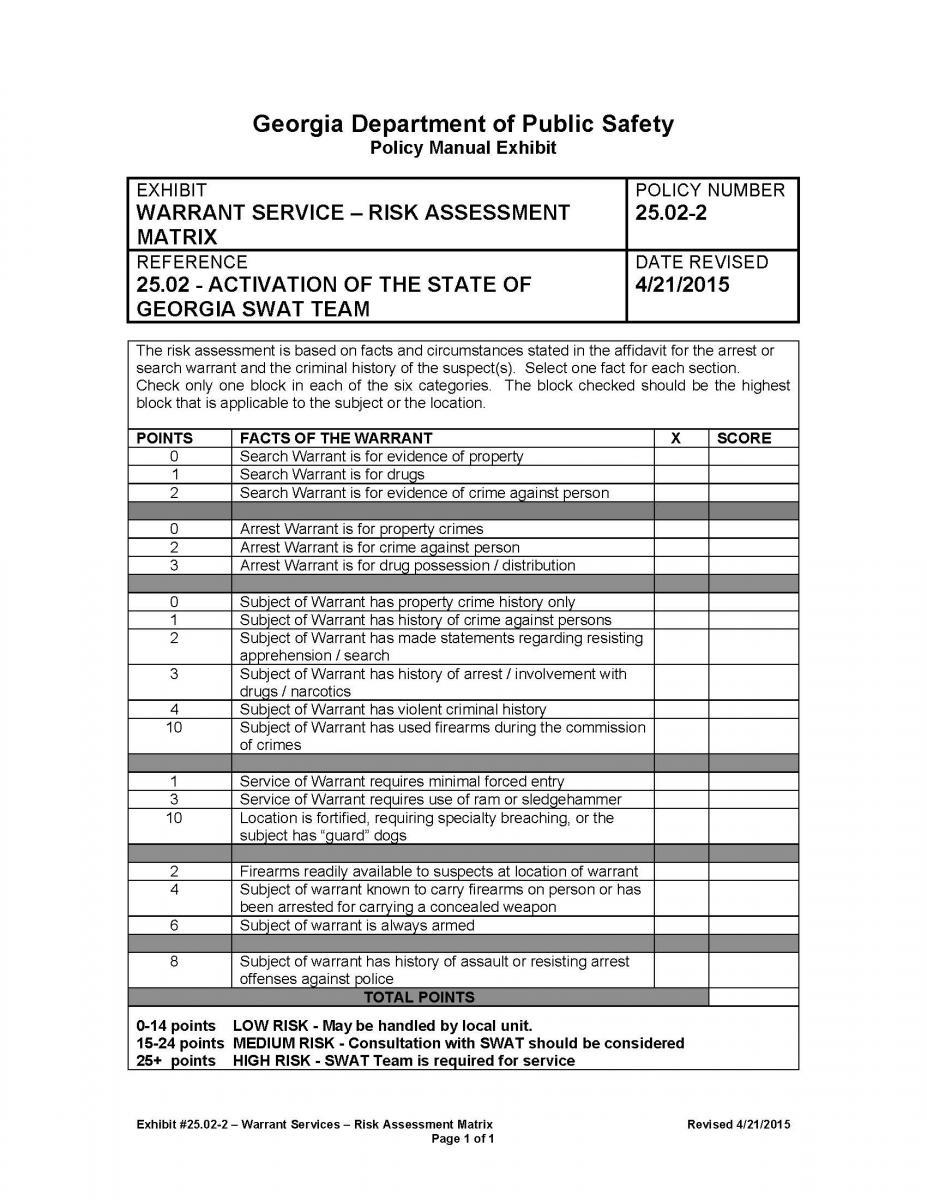
a. Should reference the matrix in Exhibit 25.02-2 of this policy to determine the risk level of a warrant;
b. Should request the assistance of the SWAT Team in planning and conducting the execution of high-risk warrants;
c. May request assistance for medium-risk warrants, and
d. Need not request assistance for low risk warrants.
D. Availability for Duty
1. It may be necessary to call-out a SWAT Team member while they are off-duty. SWAT Team members shall not respond to a call-out if they have any detectable amount of intoxicants in their system at the time of the activation. The member shall immediately notify the Element Leader of this fact and that they are not currently available for duty.
2. SWAT Team members who are unavailable for call-outs due to vacations, compensatory time off, schools, midnight shifts, etc., shall notify their respective team leader. Team members shall also advise their Element Leader of expected departure and return dates.
3. If a significant proportion of any element is unavailable, the relevant Element Leader shall notify the Tactical Team Commander.
E. Preparation Prior to the Arrival of the SWAT Team
In order to ensure a coordinated effort with minimum expenditure of time, the following preparations shall be made by the on-scene supervisor prior to the arrival of the SWAT Team:
1. Establish the following:
a. Location of the inner perimeter;
b. Outer perimeter;
c. Command post;
d. Staging area, and
e. Media area.
2. Obtain as much information as possible about the suspect(s), including name, physical description, military background, areas of specialized expertise and mental state. A criminal record check should be made to determine previous use of violence and if the suspect is wanted.
3. Obtain, if possible, first hand information concerning all locations involved. A diagram of these locations should be prepared showing entrances, exits, windows, inside rooms, adjacent buildings, and any additional information about
the location that might prove useful to the team, e.g. weapons, dogs, security devices, etc.
4. Be prepared to provide a briefing to the Tactical Team Leader.
F. Requesting SWAT Team Activation
1. When a request for the team is received by a law enforcement agency external to DPS, it shall be forwarded immediately to the Headquarters Communication Center.
a. The Communication Center shall ensure that they obtain the particulars of the requesting agency including the contact details of the individual making the request.
b. The Communication Center shall notify the SWAT Commander or their representative who shall determine whether the situation warrants the activation of the team.
c. If the team is activated, the Communication Center shall notify the Commanding Officer, Troop Officer and Post NCO responsible for the area in which the incident is occurring.
2. When a request for the team is received from within the DPS, the Troop/Region Commander or their representative shall contact the Headquarters Communication Center.
a. The Communication Center shall ensure that they obtain particulars of the requesting Troop/Region Commander including the relevant contact details.
b. The Communication Center shall notify the SWAT Commander or their representative who shall determine whether the situation warrants the activation of the team.
c. If the team is activated, the Communication Center shall notify the Commanding Officer and Post Commander responsible for the area in which the incident is occurring.
G. Standard Procedures for Team Activation
1. In the event of a SWAT Team activation:
a. The member receiving the call shall notify the Tactical Team Commander or Acting Tactical Team Commander;
b. The Tactical Team Commander or Acting Tactical Team Commander shall notify the Headquarters Communication Center, and
c. The Headquarters Communication Center shall notify affected team members by the current paging system.
2. Upon activation of the SWAT Team, the Headquarters Communication Center shall use the “command page” to notify the:
a. Commissioner of the Department of Public Safety;
b. Lieutenant Colonel (Deputy Commissioner);
c. Commanding Officer;
d. Troop Commanders, and
e. Director, Public Information Office.
f. Tactical Medics
g. Support Personnel
3. An activation of the SWAT Team shall include all available members of the Team. Only the SWAT Commander, or if unavailable, the Tactical Team Commander, or their designee can decide to activate a limited number of Team
members.
4. Each SWAT Team member shall report to the call out location as soon as possible.
H. Call-Out Status
1. The SWAT Team may be placed on stand-by at the discretion of the SWAT Commander or their designee. Stand-by refers to a state of readiness to be activated where the immediate preparations to respond have been made.
25.02-1 State of Georgia SWAT Organizational Chart
25.02-2 SWAT Warrant Service Exhibit revision
25.03 Selection of Members to the State of Georgia SWAT Team
DISTRIBUTION - ALL EMPLOYEES
DATE REVISED - 4/21/2015
25.03.1 Purpose
For the State of Georgia Special Weapons and Tactics (SWAT) Team to perform their function, well-disciplined, and highly motivated individuals are required. The purpose of this policy is to establish uniform guidelines for the selection of members to the SWAT Team.
25.03.2 Policy
It is the policy of the Georgia State Patrol to provide the best available personnel to the SWAT Team in an effort to provide the highest level of service to the Department, other law enforcement agencies, and the citizens of Georgia. Members of the Georgia State Patrol staff the element members, Tactical and SWAT Commander positions.
25.03.3 Procedures
A. Vacancies
The Commanding Officer shall advertise vacancies within the SWAT Team in conjunction with Human Resources by email, notifying potential candidates of the vacancy, the application procedure, and the minimum requirements.
B. Application Procedure
Following the receipt of applications, a four-stage selection process commences. Each stage is progressive, meaning that the applicant shall pass each stage before progressing to the next stage. Only one attempt is permitted at each stage of testing. The stages are:
1. Firearms skills assessment. (See Exhibit #25.03-1)
2. Physical skills assessment comprised of:
a. Physical fitness assessment. (See Exhibit #25.03-2)
b. Obstacle course - The applicant shall be videotaped during this component. (See Exhibit #25.03-3)
c. Swim test. (See Exhibit #25.03-4)
3. Review of the application by the SWAT Commander or their designee.
4. Oral interview before the selection panel. The panel shall be comprised of the SWAT Commander, the Tactical Team Commander, Element Leaders, a member of Human Resources and an outside Tactical Commander, which shall select the applicants with approval of the Commissioner of the Department of Public Safety.
5. The applicant shall successfully complete a Department approved 80 hour SWAT training course to become a member of the SWAT team. A certificate of completion shall be placed in the member’s 201 File.
C. Minimum Requirements
1. The applicant shall have attained the rank of Trooper through Sergeant First Class within the Department of Public Safety. Element Leaders should be of Sergeant First Class (SFC) rank, however, if no qualified SFC applies, the position may be filled by a Sergeant or lower ranking member.
2. Applicant shall not be a member of both the SWAT Team and another specialized team including the Crisis Negotiation Team (CNT), Honor Guard, and/or the Specialized Collision Reconstruction Team (SCRT).
3. The applicant shall not have received any adverse action in the two years prior to application.
4. The applicant must be a dedicated, disciplined and a team player both on and off duty.
5. The applicant shall have at least ”met” expectation on their previous two annual performance management forms (PMF).
6. The applicant (for part time positions) shall volunteer to perform duty in the SWAT Team in addition to their normal duties.
D. Selection of SWAT Commander, Tactical Team Commander, and Assistant Tactical Team Commander
The selection of the SWAT and Tactical Team Commanders are critical to the successful operation of the SWAT Team. Upon recommendation of the Commanding Officer, the Commissioner of the Department of Public Safety appoints the positions of SWAT Commander and Tactical Team Commander. The Tactical Team Commander recommends the Assistant Tactical Team Commander to the Commanding Officer, from candidates that have successfully completed the Department’s promotions procedures found in the Promotions and Transfers Policy #24.01.
Because of the nature of their assignments specific criteria are required to be met for these
positions as follows:
1. The applicant shall have at least ”met” expectation on their previous two annual performance appraisals;
2. The applicant shall not have received any adverse actions in the two years prior to application;
3. The applicant shall have at least one-year experience in SWAT Tactics;
4. The applicant shall have at least 80 hours of tactical supervision training;
5. For the SWAT Commander position, the applicant shall hold the rank of Captain or be eligible for promotion to the rank of Captain;
6. For the Tactical Team Commander position, the applicant shall hold the rank of Lieutenant or be eligible for promotion to the rank of Lieutenant, and shall possess at least two years experience with tactical application;
7. For the Assistant Tactical Team Commander position, the applicant shall hold the rank of Sergeant First Class or be eligible for promotion to the rank of Sergeant First Class;
8. For the Equipment and Logistics Officer position, the applicant shall hold the rank of Sergeant or be eligible for promotion to the rank of Sergeant;
9. For the Training Cadre Officer position, the applicant shall hold the rank of Corporal or be eligible for promotion to the rank of Corporal, and
10. All applicants, with the exception of the SWAT Commander, shall successfully complete the firearms and physical skills assessments as described for team members above.
25.03-1 Firearms Skills Assessment
DATE REVISED - 4/21/2015
A. Purpose
This course shall be used to test the practical marksmanship skills of personnel who have applied for positions in the team. It is recognized that the applicants have not received specialized training in the use of reserve weapons typically used by the team. For this reason, the applicant’s issued handgun, with which they should be thoroughly familiar, shall be used to test practical marksmanship skills.
B. Objective
1. The objective is to determine if the applicant has mastered the fundamentals of practical marksmanship. It is upon this foundation that advanced skills will be developed within each team member.
2. It is essential for all selected personnel to have a mastery of the basic skills prior to selection in order to be prepared for advanced level training, which shall commence immediately upon selection to the team.
C. Required Standard
The applicant shall fire the course three times. The first two are for familiarization, with the final attempt being scored to determine qualification.
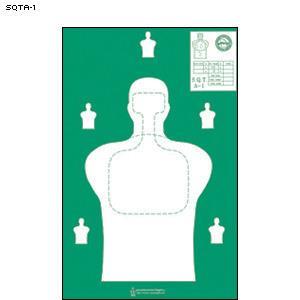
The GPA – Standard Qualification Target and scoring system shall be used. One score of 80% or better is required to pass.
1. The Course
The course includes realistic time limits, distances, and drills. It is designed to simulate 30 separate gunfights. These occur at seven to 25 yards, require from one to four rounds to solve, and last for two to eight seconds each.
All stages begin with the weapon holstered. The shooter’s hand must be off the weapon and in an interview position.
Firing position is “free-style” for all stages (standing, kneeling, or prone). Any of these positions can be used for any stage at the discretion of the shooter.
a. Stage #1 - Total of five rounds from seven yards – one round in two seconds. Repeat five times.
b. Stage #2 - Total of eight rounds from seven yards – two rounds in 2.5 seconds. Repeat four times.
c. Stage #3 - Total of six rounds from seven yards – two rounds to the body and one round to the head in five seconds. Repeat two times.
d. Stage #4 - Total of six rounds from ten yards – two rounds in three seconds. Repeat three times.
e. Stage #5 - Total of eight rounds form ten yards – two rounds, reload, and fire two rounds in eight seconds. Repeat two times.
f. Stage #6 - Total of three rounds from 15 yards – one round in three seconds. Repeat three times.
g. Stage #7 – Total of three rounds from 25 yards – one round in four seconds. Repeat three times.
h. Stage #8 - Total of six rounds from 25 yards – two rounds in five seconds. Repeat three times.
2. Scoring
The raw score shall be divided by 225. 80% of the rounds are fired from the 15-yard line or closer. A total of 45 rounds shall be fired for the course.
3. Target
The illustration shown below indicates the scoring regions of target.
25.03-2 Physical Fitness Assessment
DATE REVISED - 4/21/2015
A. Purpose
The purpose of the assessment is to determine the status and fitness level of the SWAT team.
1. The assessment shall consist of a battery of five evaluations as follows:
a. 1.5 Mile Run - The 1.5-mile run shall measure cardio respiratory fitness. The objective is to run the 1.5-mile distance as fast as possible. The running area shall be substantially level. On a standard 440-yard track six laps should be completed. Participants may be informed of their lap times. Final times shall be called out and recorded. Upon completion the participants shall be required to walk a cool down lap.
b. Push-ups - The push-up evaluation measures muscular endurance of the upper body. Hands shall be placed slightly wider than shoulders with fingers pointing forward. A three-inch sponge shall be placed under the sternum. Starting from the up position (elbows fully extended) the subject shall keep the back straight at all times and lower the body to the floor until the chest touches the sponge, the subject then returns to the up position. This shall be one repetition. Any resting shall be done in the up position. The total number of correct push-ups shall be recorded as the score.
c. One-Minute Sit-ups - The one-minute sit-up evaluation measures abdominal muscular endurance. The subject starts by lying on their back, knees bent, heels flat on the floor, with arms crossed and fingertips touching the shoulder area. A partner shall be utilized to hold the feet down firmly. The subject shall then bend upward and touch the elbows to the knees in the up position. This is one repetition. The total number of correct sit-ups in one minute shall be recorded as the score.
d. One Rep Max Bench Press - The one rep max bench press measures absolute strength. Absolute strength is defined as the amount of tension a muscle can exhibit in one maximal contraction. Using free weights and a standard bench press, start with approx 2/3 of the subject’s body weight for a male subject and only the bar (45lbs) for a female subject. Two spotters shall be used, one on each end of the bar. The spotters should lower the bar to the subject’s chest. The spotters shall release the bar and the subject shall press to a full extension while exhaling. Repeat the above until a one-rep max is reached. This should take approximately five to six trials. Once the maximum weight in pounds is determined, divide the pounds by the body weight to obtain ratio.
e. Vertical Jump Test - This is a measure of jumping or explosive power. It is an important area for pursuit tasks that require jumping and vaulting. Using a yardstick taped to a smooth wall, use chalk dust to mark the wall so that maximum height is easily determined. The subject begins with one side toward the wall and reaches up as high as possible to mark their standard reach. The subject then jumps as high as possible and marks the spot on the chalked wall above their standard reach mark. Prior to jump, one foot must remain stationary on the floor. Score is the total inches between standard reach and maximum height achieved to the nearest quarter inch. The final score shall be the best of three tries.
2. Physical Fitness Scoring Procedure
a. The physical fitness test for the SWAT team is broken down into five events. Each event has a minimum standard. If this standard is not met the new SWAT candidate shall go no further in being evaluated.
b. Each event shall be completed and shall carry from 15 to 25 points in two point increments based upon individual performance in that event (Refer to male or female standards below). The total points obtained from the five events shall be the subject’s final score.
c. A total of 100 points shall be reached in order to qualify for the team. If, however, a total of 115 points is achieved, the subject, if selected, or an existing team member shall be given a special ribbon to be worn on the uniform to signify this achievement. If a perfect score of 125 points is achieved, the subject if selected for the team or an existing member shall be awarded a special ribbon to be worn on the uniform to signify this achievement.
1) Description of Ribbons
a) A score of 100 points = a plain black ribbon signifying a current SWAT member.
b) A score of 115-124 points = a black ribbon with a vertical silver bar.
c) A perfect score of 125 points = a black ribbon with a vertical gold bar.
2) The ribbon shall be worn in accordance with the Department Awards Program Policy #20.01.
25.03-3 Obstacle Course
DATE REVISED - 4/21/2015
A. Purpose
The purpose of the obstacle course is to determine the physical capability of the member in performing tasks necessary for the accomplishment of SWAT missions.
B. Requirements
1. The course shall be run in a tactical vest provided by the training cadre. The participants shall wear their helmets and gloves. All obstacles shall be properly negotiated. Team medics shall be on hand in case of emergency.
2. Participants shall be required to perform a certain common series of physical tasks while wearing designated equipment to simulate an actual tactical operation.
C. Course
The total distance of the course is 150 yards and shall be completed in less than five minutes. The participant shall sprint between steps 1 through 12.
1. Hurdles – The participant negotiates three hurdles (5, 6, and 7 foot).
2. Wall climb - The participant climbs over a 10-foot wooden wall with the use of a rope.
3. Pole ladder - The participant climbs over a 20-foot pole ladder.
4. Hurdles – The participant negotiates three hurdles (all 4 foot).
5. Tires – The participant negotiates a series of tires laid on the ground.
6. Low crawl – The participant crawls under a chain link mesh that is 2 feet above the ground.
7. Serpentine – The participant weaves through a series of posts.
8. Balance beam - The participant traverses a beam 30 feet long.
9. Ladder climb - The participant climbs a 5-foot ladder.
10. Sprint – The participant sprints 50 yards.
11. Wall climb - The participant climbs over a 6-foot wall unaided.
12. Body drag - The participant drags 165 lb. dummy 20 yards.
25.03-4 Swim Test
DATE REVISED - 4/21/2015
The swim test is comprised of the following exercises:
A. Demonstrate the ability to swim 50 yards without any type of flotation device without touching bottom.
B. Demonstrate the ability to tread water for five minutes.
25.04 Motorcycle Unit
DISTRIBUTION - ALL EMPLOYEES
DATE REVISED - 8/31/2010
25.04.1 Purpose
The Georgia State Patrol Motorcycle Unit is a valuable element of the department, created to enhance traffic enforcement, motorist safety, and public relations. The purpose of this policy is to establish the mission and duties of the Georgia State Patrol Motorcycle Unit.
25.04.2 Policy
It is the policy of the Georgia State Patrol to maintain the highest level of integrity in the selection, training and operation of the Motorcycle Unit. This policy serves to provide procedures, guidelines and requirements that regulate the operation of Georgia State Patrol Motorcycle Unit.
25.04.3 Procedures
A. Objectives
1. To preserve the safety of the motoring public.
2. To complement and enhance the patrol function of the Georgia State Patrol.
3. To reduce the number of traffic crashes on Georgia’s roads through increased presence and visibility.
4. To respond to emergencies in a versatile manner, utilizing the maneuverability of the motorcycle.
B. Authority to Operate
Only the following members are permitted to operate Georgia State Patrol motorcycles:
1. Those members selected for motorcycle duty who possess a valid motorcycle license and have successfully completed the prescribed training course; and
2. Those members selected for motorcycle duty who possess a valid motorcycle license and are participating in the prescribed training course.
C. Training
1. Upon assignment to the Motor Unit, all members shall successfully complete a departmental/P.O.S.T. approved Basic Police Motorcycle Operator’s Course.
2. If a member fails to successfully complete the basic course after remedial training, the Unit Commander shall notify the Commanding Officer thru the chain of command.
a. For the purpose of this policy, remedial training shall consist of attending the entire Basic Operator’s Course for a second time.
3. In order to preserve the credibility and integrity of the Motor Unit’s Training program, any member who fails to successfully complete the remedial training shall be reassigned to another post/unit as deemed necessary by the Commanding Officer.
4. Annual Re-Certification
All personnel must successfully complete an annual proficiency course of training in order to remain an active member of the Motor Unit. Any member who fails to successfully complete the re-certification training shall be subject to the same actions as stated in paragraph three above.
D. Equipment
1. All equipment for members of the Motorcycle Unit, including uniforms, shall be authorized by the Commanding Officer. Any exceptions shall be authorized in writing.
2. Motorcycles and all accompanying equipment shall be distinctly marked as determined by the Commanding Officer.
3. Unauthorized equipment and personal modifications shall not be permitted on motorcycles. This includes decals, stickers and tags.
4. Small first aid kits and fire extinguishers may be carried if space is available.
5. Inspections of motorcycles and equipment shall occur in accordance with DPS Inspections Policy #9.01.
E. Uniforms
1. Class A and B Uniform shall consist of that described in DPS Uniform and Appearance Policy #6.01, with the following exceptions:
a. Helmet;
b. Britches;
c. Riding boots;
d. Black leather motorcycle jacket, and
e. Black leather gloves.
2. No exceptions shall be made to the uniform policy.
F. Patrol Procedures
1. When performing traffic stops, the motorcycle engine shall be turned off.
2. Members who make an arrest which requires prisoner transport shall request the presence of a trooper in a patrol car to respond to the scene for that purpose.
3. In a pursuit, if the primary unit is a patrol motorcycle, it will yield primary position to a marked patrol car. The patrol motorcycle will discontinue pursuit when a secondary patrol car becomes involved, but will proceed to the termination point of the pursuit to provide guidance and information required for arrest. Further instructions on pursuits can be found in DPS Pursuits Policy #17.02.
4. During periods of inclement weather, when the operation of a motorcycle is unsafe or impractical, members shall perform duties in their assigned patrol car. If inclement weather develops after the commencement of a member’s shift, they may await the passage of the inclement weather not to exceed 30 minutes. If the inclement weather passes and the supervisor deems the roadway safe, motorcycle patrol may resume.
G. Maintenance
1. Motorcycles shall be maintained properly at all times. Maintenance/services will be conducted in accordance with manufacture’s specifications. A pre-ride inspection will be conducted by the operator prior to each shift. It shall include a check of: oil level, tire wear/pressure, drive belt, range of motion of handlebars, headlights, taillights, turn signals and emergency equipment.
2. Motorcycles shall be kept in a clean condition and shall be checked for cleanliness by supervisors as appropriate.
3. All warranty and non-warranty repair work shall be completed by authorized personnel approved by the Motorcycle Unit Commander.
H. Security
1. The member assigned the motorcycle shall ensure that, when it is not in use, it is housed in a secure location that provides shelter from the elements.
2. The motorcycle’s steering lock mechanism shall be utilized to ensure its security. The key shall be removed from the ignition and stored in a separate safe location.
I. Escorts
Off-duty escorts are not permitted. On-duty escorts may be provided under the following circumstances:
1. When specifically required to do so by statute;
2. When public safety will be enhanced by such presence;
3. When requested for the security of dignitaries such as the President of the United States, Governor of the State of Georgia, etc. with approval from Troop Command.
4. At funerals of police officers killed in the line of duty, or other funerals of dignitaries upon request, with approval from Troop Command.
25.05 Executive Security
DISTRIBUTION - ALL EMPLOYEES
DATE REVISED - 4/28/2006
25.05.1 Purpose
A. To establish the policy of the Georgia State Patrol (GSP) regarding dignitary protection and facilities security.
B. To define the organizational structure responsible for delivering these services.
C. To establish procedures for providing these services.
25.05.2 Policy
A. It is the policy of the GSP to provide effective, efficient dignitary and facilities security services for individuals and facilities as described or authorized in state statute.
25.05.3 Definitions
A. Commissioner — Commissioner of the Georgia Department of Public Safety.
B. Protectee – A person who is the subject of personal protection services as required or authorized by state statute including but not limited to: specific government officials and facilities, political luminaries, government officials, and famous or notorious persons.
C. Unit Member– A sworn State Trooper regardless of rank (e.g., trooper, corporal, sergeant, etc.) assigned to the Dignitary Protection Section whose primary responsibility is the security of protectees.
25.05.4 Authorities
A. OCGA § 35-2-73 (a) which states: “The commissioner shall be authorized to employ such number of security guards as may be necessary to keep watch over and protect the Governor and members of his immediate family, the Lieutenant Governor and members of his immediate family, the Speaker of the House of Representatives and members of his immediate family, the executive department at the state capitol or at any other place as the executive department may be moved, the executive center or other residence of the Governor, the residences and offices of the Lieutenant Governor and the Speaker of the House of Representatives, and such other state property and individuals as may be directed by the Governor.”
B. OCGA § 35-2-73 (b) which further states: “Members of the Governor's family, the Lieutenant Governor’s family, and the Speaker's family for whom protection is provided by the Security Guard Division, when traveling with the Governor, the Lieutenant Governor, or the Speaker, as the case may be, when traveling on state related business at the request of the Governor, the Lieutenant Governor, or the Speaker, as the case may be, or when in the judgment of the commissioner security considerations so dictate, may be transported by means of state owned transportation facilities, when appropriate, or at state expense by private carrier, when the use of such state owned facilities are not practical or appropriate.”
25.05.5 Organization
A. The Executive Security Unit consists of two Sections.
1. The Special Services Section provides security services for the Governor’s Mansion and its grounds.
2. Dignitary Protection Section provides protection services for those protectees designated by the Commissioner.
B. The Commissioner may appoint, without competitive examination, a Director of the Executive Security Unit. The Director shall administer the Division’s responsibilities as described herein.
1. The Director of the Executive Security Unit shall be a Unit Member and hold the rank designated by the Commissioner.
C. The Commissioner shall appoint as many officers and personnel as necessary to adequately staff the Division and may assign additional staff on a temporary basis to augment the Division’s resources.
1. Members assigned to the Dignitary Protection Unit shall be carefully screened and reviewed with appointments made from the GSP and shall be without competitive examination. Other personnel hired for or assigned to the Division shall meet minimum hiring guidelines then in place for the position filled.
2. Personnel assigned to the Division may be reassigned to other duties within the Department at the discretion of the Commissioner without recourse.
D. The Division shall:
1. Provide the protection, security and police services as described herein;
2. Strive to train personnel in the unique services the Division is called on to deliver;
3. Strive to provide necessary and appropriate equipment to facilitate the Division’s mission;
4. Maintain a confidential, current security file for each protectee, and
5. Maintain a confidential, current medical file on protectees including such appropriate information as blood type, allergies, physician information, etc.
25.05.6 Procedures – Dignitary Protection
A. Protectees may waive or modify the delivery of the security services herein described but, protectees should be encouraged to accept the services delivery as described, under normal circumstances. If a permanent waiver or modification is requested, the Director of the Executive Security Unit and the Commissioner should be notified as soon as practical. The Commissioner may ask the Director for a written report outlining the circumstances surrounding such a waiver. Temporary waivers or modifications shall be at the Unit Members’ discretion.
B. Unless otherwise directed by the Commissioner, protection services will be provided 24-hours a day regardless of the nature of protectees’ activities. At all times during normal business hours Unit Members should directly observe protectees. When direct observation is impractical, impossible, or inappropriate, Unit Members should control access to protectees, screen visitors, and, if possible, monitor protectees electronically.
C. Unit Members may prohibit or restrict access to protectees at the Member’s discretion when such prohibition or restriction is deemed necessary for the security of protectees and others. Should such action be necessary, the Unit Member shall notify, as soon as possible, a supervisor who then shall notify the Director of the Executive Security Unit who, if such prohibition or restriction is expected to remain in effect for four or more hours, shall notify the Commissioner. No such prohibition or restriction order shall remain in effect for more than three consecutive days without the approval of the Commissioner.
D. Travel and Lodging for Security Details:
1. Ground Transportation:
a. When traveling by vehicle, whether state-owned or privately owned, a Unit Member shall drive the vehicle, unless special circumstances dictate otherwise. If special licensing is required by law, a Unit Member shall ensure compliance.
b. When traveling by ground transportation, such travel, when practical should be by the vehicle designated for the protectee.
c. If traveling outside Georgia, Unit Members shall prearrange suitable ground transportation. If a rental vehicle is used, Unit Members shall visually inspect vehicles prior to transporting protectees to ensure the vehicle is mechanically sound. This inspection shall also include a search of the vehicle for any items that may pose a threat or be offensive to the vehicle’s occupants.
2. Air Transportation:
a. If travel is on any commercial, state agency or National Guard aircraft, it shall be assumed that the aircraft is airworthy and that pilot certifications are in order.
b. Should the protectee choose to travel on privately owned and operated aircraft for political or personal business, the following policy should be followed:
1) Unit Members shall obtain in advance the make, model and type of aircraft to be used.
2) Unit Members may request that the pilots produce FAA credentials if questions exist as to their qualifications. Credentials can be legally requested by a peace officer at any time. At a minimum, the pilot should possess a valid second-class medical certificate and an FAA issued pilots license. The minimum acceptable standard to transport a protectee in the care of the Division shall be a commercial license with a rating commensurate to the type of aircraft to be flown (e.g., single engine, multi-engine, etc). If the flight is to occur in darkness or inclement weather, instrument rating will also be required. If the flight is to occur at night or in inclement weather, a multi-engine aircraft should be utilized.
3) Unit Members should accompany protectees, unless otherwise directed by the protectee, on any flight regardless of the purpose of the flight.
3. Lodging:
a. If protectees are to remain away from their residence at a location not owned by protectee or a family member, Unit Members shall inspect the location for suitability and security precautions prior to protectees’ arrival.
b. Unit Members shall have the option of accepting or rejecting lodging accommodations if, in their opinion, conditions warrant such actions.
E. Assigned Unit Members shall ensure that appropriate, necessary, and applicable procedures are followed including but not limited to:
1. Arrangements shall be made to acquire all necessary equipment for Unit Members (e.g., vehicles, weapons, radios, cellular phones, etc.) and protectees (e.g., body armor).
2. Unit Members should:
a. Identify and test primary, alternate and escape routes in advance of protectees’ use with consideration for the location and impact of detours and other potential traffic problems.
b. Inspect sites and facilities in advance of protectees’ use.
c. Identify and, if appropriate, contact medical and fire services in advance of protectees’ visits or events.
d. Contact federal, state and local authorities to gather intelligence information pertinent to protectees’ visits or events.
3. Supervisors or lead Unit Members should insure that Unit Members assigned to protectees or functions are provided with proper identification lapel pins established for the time of the visit or other appropriate predetermined identification.
4. Uniforms
a. Due to the nature of the assignment, Unit Members, while working on assignment with protectees, shall dress in civilian business attire in lieu of the otherwise designated uniform. Unit Members shall:
b. At all times while on assignment carry the assigned duty weapon(s), and
c. Be eligible for a quarterly clothing allowance to be paid following conclusion of the quarter.
d. All other personnel shall be uniformed as otherwise directed.
25.05.7 Procedures – Special Services Section
A. The Special Services Section shall provide facility security services for the Governor’s Mansion and its grounds including but not limited to the following:
1. Screen visitors to the Governor’s Mansion being alert to potentially dangerous devices, persons or groups, and behaviors, and
2. Patrol the mansion and grounds, and monitor security systems.
25.06 Specialized Assignments
DISTRIBUTION - ALL EMPLOYEES
DATE REVISED - 10/17/2016
25.06.1 Purpose
To identify specialized assignments within the Georgia Department of Public Safety.
25.06.2 Policy
To effectively accomplish the mission of the Georgia Department of Public Safety (DPS) it is necessary to assign sworn members to certain specialized assignments. These assignments shall generally require special skills and abilities unique to the assignment.
25.06.3 Procedures
A. The following shall be considered specialized assignments:
1. Aviation;
2. Specialized Collision Reconstruction Team (SCRT);
3. Safety Education;
4. Implied Consent;
5. Office of Professional Standards;
6. Training Division;
7. State of Georgia SWAT;
8. Criminal Interdiction Unit;
9. GSP Dive Team;
10. Crisis Negotiators;
11. Executive Security;
12. DUI Task Force (Nighthawks);
13. Communication Services;
14. Honor Guard;
15. Regional K-9 Task Force;
16. GEMA Liaison;
17. FBI Liaison;
18. GOHS Liaison;
19. Governor’s Task Force for Marijuana Eradication;
20. GISAC Officer;
21. Canine Handlers;
22. Specialized assignments such as Drug Task Forces, Fugitive Squads, etc.;
23. MCCD Compliance Review, Safety Audits, and
24. Any other unit or assignment which requires specialized training, skills or abilities not normally required on a day-to-day basis by sworn members assigned to field operations.
B. The procedures for filling vacancies to specialty units/positions are outlined in DPS policy #24.01 Promotions and Transfers.
25.07 Canine Teams
DISTRIBUTION - ALL EMPLOYEES
DATE REVISED - 2/21/2013
25.07.1 Purpose
The Georgia Department of Public Safety canine teams are a valuable aid to law enforcement for use in criminal apprehension, evidence and missing person location, narcotics and explosive detection, and public relations. The purpose of this policy is to outline the use, training, equipment, and selection process of members to the position and the manner in which handlers are to be activated when required.
25.07.2 Policy
It is the policy of the Georgia Department of Public Safety to provide support to its members and other law enforcement agencies with reliable, highly trained canine teams capable of supporting varying missions throughout the State of Georgia.
25.07.3 Procedures
A. Organization
1. To ensure proper representation and coverage throughout the State, canine teams are comprised of the following personnel:
1) Sworn members located in strategic positions throughout the State;
2) Members assigned to the Criminal Interdiction Unit (CIU), and
3) Members of the SWAT Team.
2. All canine teams will report to their respective Chain of Command with the following exceptions:
a. The Canine Unit Commander shall be designated by the Commissioner. The Canine Unit Commander is responsible for the overall standards and procedures associated with the Canine Unit.
b. The Canine Supervisors shall be a NCO or commissioned officers recommended by the Canine Unit Commander and approved by the Division Director, to be the primary contact persons for canine related questions and issues, and shall act as a liaison between the Canine Unit Commander and field supervisors. The Canine Supervisor shall also be responsible for inspection of canine teams and equipment.
c. The Canine Training Coordinator shall be a certified training instructor responsible for scheduling and documenting internal training sessions, the maintenance of the training facilities, and training aids.
d. The Canine Training Instructor shall complete an approved training certification course within 18 months of appointment.
3. The CIU and SWAT handlers will report to their Unit Commanders.
4. Canine handlers shall perform this duty in addition to their regular duties.
B. Qualification and Selection Process
1. When positions as canine handlers on the Georgia State Patrol, MCCD or Capitol Police become available:
a. The Division Director shall announce the vacancies in conjunction with Human Resources;
b. A member shall submit a resume and application to Human Resources.
c. Interviews will be conducted by an interview panel consisting of:
1. The Canine Unit Commander;
2. The Canine Supervisor;
3. The Canine Training Coordinator;
4. One current canine handler, and
5. A member of the Human Resources Division.
d. The panel shall provide the Division Director with a recommendation based on the results of the interview procedure.
e. The selection of a suitable candidate(s) shall be approved by the Division Director.
C. Minimum Requirements
1. To be eligible for selection as a canine handler, the applicant shall:
a. Be a sworn member within the Department of Public Safety;
b. Have received a ”met expectations” rating or higher on up to the last three previous annual performance appraisals;
c. Have no formal disciplinary action within the previous year;
d. Pass the department’s physical fitness assessment and maintain a regular exercise regimen;
e. Be a non-smoker or agree to not smoking in the patrol vehicle or in the presence of the canine;
f. Have excellent written communication skills, and be very proficient in record keeping, and
g. Have an appropriate living situation which may include:
1) Residing in a single family residence.
2) Suitable location to construct a kennel to Department standards.
3) Support of spouse/family. Note: Serving as a Canine Handler should be a family decision due to the impact that the canine will have on a handler’s family. The canine program requires the entire family's full cooperation to be successful, as the canine will become a part of the family's life. Family members are to be made fully aware of the requirements of this program.
4) No family member with allergies or phobias regarding canines.
5) No restrictive neighborhood covenants/regulations prohibiting maintaining a kennel on premises. If an applicant lives in a restricted community or rental property, written permission to construct and maintain a kennel on the premises must be obtained from the homeowner’s association or landlord.
2. The applicant shall agree to the following:
a. Provide suitable housing for the canine at their residence;
b. Properly train and care for the canine;
c. Recognize that the position requires unusual and extended working hours;
d. Recognize that there is inherent potential for damage to personal property from the canine that could result in the potential for personal liability;
e. Recognize that the canine handler’s primary responsibility is to perform the duties of a Georgia State Patrol Trooper/State Officer unless assigned to specific canine duties, and
f. Participate in demonstrations, appearances and public speaking engagements as required.
3. Canine Handlers should be prepared for assignment for a minimum of three years.
D. Removal
There are several factors that influence the decision to remove a member from the unit. They may include, but are not limited to:
1. Any formal disciplinary action;
2. The failure of the member to attend and complete required training;
3. A failure to obtain at least “met expectations” on the members’ most recent performance appraisal;
4. Failure to maintain the canine to minimum established standards of health, maintenance, and certifications;
5. Unsatisfactory job performance;
6. Failure to respond to a call for service;
7. Determination by the Division Director that removal is in the best interest of the Department, and
8. Voluntary removal after the member submits a written request to the appropriate Division Director advising of the effective date of inactive status.
E. Training
1. Upon initial assignment, the member is required to successfully complete a department approved course prior to being certified as a canine handler. The Canine Training Coordinator and any other canine instructors shall be required to successfully complete an approved Canine Instructor certification class within 18 months of assignment. All training classes shall be POST certified or equivalent.
2. In addition to the initial training, the canine handler is required to complete ongoing training as required by the department.
a. Canine teams shall attend a minimum of 16 hours of in-service training per month unless temporarily waived by the Canine Unit Commander. Advanced handler courses and seminars recommended by the Canine Training Coordinator and approved by the appropriate chain of command may also be required. Additional training sessions may be required if the canine team is not performing to established standards.
b. Canine handlers may request additional maintenance training when they believe it would be beneficial and shall be allowed to attend additional training when approved to do so by the Canine Training Coordinator.
c. This training shall be properly documented on the canine’s training records.
3. Only members who have completed the required selection process and initial training are authorized to handle department canines on a routine basis.
4. Canine teams may be issued surrogate odors to be used for training aids. Surrogate odor scents shall be stored in airtight containers according to manufacturer directions. A separate container shall be used for each specific odor. Actual controlled substances may be used during coordinated training sessions with the approval of the Canine Training Coordinator or Canine Training Instructor. The Canine Unit Commander, Canine Supervisors, Canine Training Coordinator, or Canine Training Instructors are authorized to possess controlled substances for the purpose of narcotics training and shall abide by DEA guidelines for obtaining the proper license for handling and transporting of such substances. Controlled substances to be used as training aids shall be maintained and stored according to the DEA guidelines. Controlled substances shall not be stored in a patrol vehicle any longer than necessary to transport the items to or from a training location. Any member who loses or has training aids that are damaged/destroyed shall immediately report the matter through the Chain of Command to the appropriate Division Director.
5. The use of explosive training aids consisting of different odors, sizes, and amounts and set in various environments is vital in maintaining the effectiveness of Explosive Detection Canine Teams. Explosive training aids could be hazardous to public safety. Surrogate odors may be issued as explosive training aids. Even those training aids that are relatively inert or safe, by their very nature, are perceived to be dangerous by those not familiar with their limitations. Subsequently, it is important careful handling and tracking procedures for training aids are followed at all times. Any member who loses or has training aids that are damaged/destroyed shall immediately report the matter through the Chain of Command to the appropriate Division Director.
6. Explosive Detection Canine Teams will work with area Bomb Squads to maintain an effective training plan to include scenarios. The teams will work closely with Bomb Squads during training and actual events.
F. Certification
1. All Departmental canine teams shall maintain an annual inter-departmental certification based on established guidelines for that team’s required skills. The annual certification shall be administered by the Canine Training Coordinator or his or her designee.
2. Canine teams will also maintain an annual certification by at least one nationally or internationally recognized certifying agency (i.e. PSP, NAPWDA, NNDDA, USPCA, etc.) or, shall be certified annually by an approved vendor. The Department shall not endorse one certifying agency or vendor over another and shall not allow one training style to dictate the entire program. Copies of certification documents shall be provided to the Canine Training Coordinator.
3. Canine teams trained in certain specialties that require additional certifications, such as explosive detection or search and rescue, shall obtain those certifications as required.
4. Canine teams that fail a certification trial shall notify the Canine Unit Commander through their Chain of Command within 24 hours. The Canine Unit Commander shall arrange for remedial training through the Canine Training Coordinator. The canine team shall be required to re-certify with the failing agency/vendor within 30 days. It shall not be permissible to seek certification through another agency/vendor in an effort to circumvent the certification process unless there is probable cause to believe that the original certification trial was handled inappropriately. Should the canine team fail the second attempt at re-certification, the Canine Unit Commander will evaluate the situation and may recommend that the canine be removed or reassigned to another canine handler in accordance with Section D. of this policy. The Canine Unit Commander shall investigate any allegations of misconduct in the certification process.
5. Expenses incurred for certification procedures shall be processed in accordance with the Department’s purchasing guidelines.
G. Canine Selection
1. The Department of Public Safety may utilize single-purpose canines for explosive detection and SWAT. Narcotic detection canines may be single-purpose or may be cross-trained for handler protection and/or tracking.
2. Detection Canines will be passive alert and source oriented.
3. Various breeds may be used, but it is recognized that certain breeds may perform better in a designated role over another. The Canine Unit Commander may work with vendors and handlers to select the best canine candidate for a particular situation.
4. Canine candidates shall be pre-screened for illness and genetic deficiencies by a qualified veterinarian prior to acquisition by the Department.
5. Department canines shall not be used for breeding purposes without the consent of the Canine Unit Commander. All female Department canines shall be spayed at their appropriate life cycle. Neutering male canines may affect their internal drive and will be done only upon a determination that it is in the best interest of the canine and approved by the Canine Unit Commander.
6. Any canine nominated for donation to the Department of Public Safety shall be subject to the pre-screening requirements. If the canine is not being purchased for donation direct from a vendor, then the Canine Unit Commander, Training Coordinator and other persons deemed appropriate by the Canine Unit Commander shall evaluate the canine prior to submission of the donation request to the Board of Public Safety.
7. The Department of Public Safety will retain the authority to return any canine to a vendor, within contract limits, for replacement or refund if that canine is deemed to be un-serviceable based on training or temperament.
H. Specialty Use
1. Narcotic Detection Canine Teams shall be utilized according to State and Federal Laws. The following circumstances should determine the deployment of a narcotics canine team:
a. When probable cause has been established from a search incident to an arrest.
b. When probable cause has been established to execute a search warrant.
c. A legal traffic stop has been made and consent to search has been given to an officer to search and utilize a narcotics canine.
d. When reasonable, articulable suspicion exists to justify a free air sniff of an area, vehicle, or building/storage locker.
e. When probable cause has been established for a search warrant through the use of a canine. Note: A positive canine alert may be used to establish probable cause for a search warrant and its execution.
2. When a Narcotics Detection Canine is used to sniff currency for the purpose of identifying the presence of narcotics or narcotic odor, the following standard procedures should apply if possible:
a. Currency sniffs should be conducted at the location where the money is discovered.
b. A minimum of three paper bags or similar containers will be used.
c. Each container will be numbered prior to placing objects within the container.
d. Suspected contaminated money will placed in one container.
e. All containers will be configured so they are similar in shape and size.
f. The location of the contaminated money will be unknown to the Canine Handler prior to the sniff.
3. Explosive Detection Canine Teams shall only be used in accordance with State and Federal laws.
e. When conducting an explosives search, unnecessary people shall be removed from the area. A bomb technician or designated spotter will assist the Explosive Detection Canine Team with the search. A canine team will not enter or search without the assistance of a spotter or observer.
f. When practical, a Consent to Search form shall be completed and signed by the owner or property custodian prior to the search. A Consent to Search form may not be necessary for searches of state property.
g. When conducting an explosives search where a specific detonation time has been given, the canine team will withdraw to a safe area one half-hour before the indicated detonation time and should not reenter the search area sooner than one-half hour after the detonation time.
h. Depending on the information available to the handler, the final decision relating to the timing of the search rests with the handler as to when to act and/or reenter the area to be searched.
i. Explosive Detection Canine Teams are appropriate for searching buildings, vehicles, baggage, packages, aircraft, etc., during threats, protection details, or other routine or general sweeps, but are not to be used to assess, examine, or clear items already identified as suspicious, a suspected explosive item, or possible improvised explosive device. In instances where an item is already identified as suspicious, a Bomb Technician shall be called and an Explosive Detection Canine Team should be used to provide a sweep of the surrounding areas and command post vicinity for secondary devices.
4. Patrol dog teams used for tracking suspects should follow the below procedures:
a. The handler should make contact with the requesting party to obtain all pertinent information regarding the circumstances.
b. The handler should become familiar with the search area and any perimeter that has been established.
c. The handler should designate a minimum of one cover officer to accompany the tracking canine.
d. The canine team or the cover officer should ensure that they have some form of communications with the perimeter officers.
I. Activation
1. Criteria for Activation
Canine handlers may be activated for incidents that fall in the following categories:
a. Searches for Contraband and Narcotics
Members may request activation of a canine handler when they reasonably suspect that a vehicle, dwelling or building may contain a controlled substance or contraband.
b. Emergency Situations
Members may request activation of a canine handler to assist in the resolution of an immediate or ongoing situation. This may include incidents such as
1) area searches and
2) pursuits.
2. Authority to Activate
a. Activation of canine handlers may be authorized by the handler’s supervisor, for incidents which fall into the above described categories. Supervisors also have the authority to deny the activation of canine handlers upon evaluation of a request.
b. Canine handlers are available, with the approval of the supervisor, to members of the sworn divisions of the Department of Public Safety or any requesting law enforcement agency in the State of Georgia.
3. Response to Incidents
a. Handlers and their canine shall not be activated to respond to an incident for which they have not received specialized training.
b. Handlers will have the ultimate authority to determine whether or not the requested response meets the criteria for which the canine team has received training.
J. Call-outs
1. Canine handlers may be activated while they are off duty.
2. The affected canine handler’s supervisor shall be contacted to authorize the response during the canine handler’s off-duty hours.
3. The affected canine handler and supervisor shall consider the response time for the canine to arrive on the scene to prevent unnecessary detention.
K. Emergency Control of Canine
Should a canine handler be injured or incapacitated to the extent they cannot give commands to the canine and the canine prevents assistance being given to the canine handler, the following procedures shall be used, if possible:
1. Open the rear door of the canine handler's patrol vehicle and give the canine a command to load into the vehicle. If the handler's vehicle is not available, another patrol vehicle may be used.
2. Call another experienced law enforcement canine handler to the scene to assist.
3. If the canine is trained in apprehension tactics, attempt to use the protective sleeve in the trunk of the canine handler's patrol vehicle to move the canine into the rear of the vehicle.
4. Call the local animal shelter and advise them of the circumstances. Request the use of a catch pole or tranquilizer gun if required.
5. Use of deadly force against a canine that is protecting its handler shall only be used as a means of last resort, and only if failure to immediately act would reasonably be expected to result in serious injury or death to the handler.
L. Conditions of Use
1. A trained canine shall not be used as an instrument of force except under the following circumstances:
a. When the canine or canine handler is assaulted;
b. To apprehend a suspect whom the officer reasonably believes has committed a criminal act and the release of the canine is justified as an appropriate level of force;
c. To prevent serious injury/death to a law enforcement officer or a citizen.
2. In order to minimize the risk of injury to the canine, Canine Handlers initiating a vehicle pursuit should relinquish the primary role to the first marked State Patrol unit that arrives if practical. The same consideration should be given prior to a canine vehicle being used for the Precision Immobilization Technique (PIT) maneuver.
3. The safety of the public and the performance of the canine are priorities of each canine handler.
4. Canines are not to be utilized for civil disorder situations without the express consent of the Division Director.
5. Canines shall not be left unattended in a manner in which they may have contact with the public or be placed in danger.
6. While on routine patrol, canines shall remain in the caged area of the patrol vehicle. Canines shall not ride in the front seat area of the vehicle.
7. Under no circumstances shall the canine be allowed or encouraged to jump on or be permitted on the exterior of the patrol vehicle.
8. Under normal circumstances, only the canine handler shall feed, handle, exercise or give commands to their assigned canine.
9. Canines shall not enter restaurants or other business establishments unless duty related and under control of the canine handler.
10. Canines shall be kept in locked kennels except when under direct supervision and control of the assigned canine handler or their designee.
11. Canines shall not be allowed off-lead in a non-work environment when non-family members are present in the area. Canine Handlers should exercise extreme caution when any non-law enforcement personnel are present in the area of the canine.
12. The canine handler shall not demonstrate the canine's abilities except at authorized demonstrations.
13. The canine handler shall carefully consider the propriety of taking the canine on personal outings and shall maintain strict control and security of the canine at all times.
14. Under no circumstances shall the canine handler allow another Department member or citizen to intentionally tease or agitate their assigned canine except during authorized training sessions by qualified personnel participating in the training.
15. The canine handler and a Department supervisor shall examine all alleged injuries inflicted by a canine on any person or animal. Medical attention shall be provided immediately to any injured person. The canine handler shall make color photographs of all alleged injuries, regardless of the suspected nature of the injuries following medical treatment by qualified personnel. The canine handler shall complete a memorandum to the Division Director explaining the circumstances for any non-law enforcement related incident.
a. In the event that the incident is related to a law enforcement action, a DPS 1113 Incident Report shall be utilized.
b. A Use of Force Report shall be completed if applicable.
c. The Director of Legal Services shall be notified of any alleged injury within 24- hours and furnished a copy of the Memorandum or Incident Report and all supporting information as soon as practical.
M. Limitations of Use
Use of Departmental canines during off-duty employment is prohibited.
N. Care of Canines
Canines entrusted to a canine handler are the sole responsibility of the canine handler for care, feeding, grooming, cleanliness, training and maintenance of performance standards. Payment of services discussed below shall be processed through the Department’s budget procedures.
1. Canines shall be groomed, inspected and handled daily.
2. The canine's kennel shall be cleaned daily and maintained in a sanitary condition.
3. Canine food, supplies and equipment shall be secured by the canine handler as needed using departmental purchasing procedures. Supervisory approval must be obtained for any expenses exceeding established spending guidelines. Approved purchases may be made utilizing the Post/Unit/Section Purchasing Card.
4. The canine handler shall obtain the service of a local veterinarian as needed. Any expense involving veterinary services must be processed according to departmental guidelines.
5. The handler is responsible for the acquisition of the rabies tags, upkeep of vaccinations, and compliance with all state, county, and city ordinances regarding licensing of their canines. The records will be maintained in the canine’s diary. The department purchasing procedures will be used for the required fees.
6. Kennel Boarding may be authorized for non-aggressive canines if a canine handler would be unable to provide adequate care for his or her assigned canine for an extended period of time. A request for kennel boarding must be pre-approved by the handler’s supervisor. Law enforcement kennel boarding will be utilized if available. Civilian kennels will only be used for non-aggressive canines and must meet minimum state certification standards. Aggressive canines or patrol dogs should be kenneled with another handler or at an approved law enforcement facility.
7. Adult family members or other qualified adults may provide short term care for a Department canine in the member’s absence only after being properly instructed by the member on correct handling procedures. The selected adult person shall not allow the canine off-lead or out of its kennel area unless absolutely necessary. Special consideration should be given before selecting any adult person to act in this capacity as any such selection carries an inordinate amount of personal responsibility.
8. In an emergency medical situation, the canine handler or designee shall ensure that the canine receives immediate medical attention. After medical attention has been rendered to the canine, the canine handler shall forward a memorandum, through channels, to the Division Director describing the incident that caused the need for emergency medical attention. If treatment would exceed established spending limits, verbal supervisory approval shall be received before services are rendered, if practical.
9. The canine handler shall be responsible for the administration of any medication as prescribed by the veterinarian after the canine has been released from the veterinary establishment.
10. Canine medical examinations shall be conducted annually or as needed should an injury or illness occur.
11. The handler shall ensure their assigned canine wears a soft collar with identification tags at all times when not working. The identification tag shall include the handler’s personal information and/or a local 24-hour communication phone number. The canines working collar or harness will also have identification tags when practical. The information on these tags will identify the Georgia Department of Public Safety and a local 24-hour communication phone number. Microchip identification tags will also include 24-hour communication division phone numbers.
12. Members assigned the responsibility of canine handler are scheduled an additional 14 hours during each 28 day roster for the responsibilities associated with the health, maintenance, handling and grooming of their canines. These hours shall be recorded on the appropriate activity/time sheets every Sunday on a 4/3/4/3 basis. The time shall be carried under the “OTHER NON-ENFORCEMENT HOURS” area.
13. Exercising and training of canines shall be conducted with the canine on lead at all times unless the handler determines that there are no risks present with having their canine off lead. The handler shall take into consideration the presence of any other animals or persons in the area, and the possibility of their canine escaping their control before allowing them off lead. Portable warning signs should be posted in the exercise/training area warning that a police working dog is present in the area.
14. Handlers are responsible for cleaning and properly discarding any mess caused by their canines, including feces dropped in public areas or on private property.
O. Required Equipment
1. Patrol vehicles are to be locked and secure when the canine is left in the vehicle and the handler is not present. Patrol vehicles shall display a uniform canine warning sign. Patrol vehicles shall be maintained in a clean and healthy condition for the canine. Patrol vehicles shall be subject to routine inspections by the Canine Supervisors. Mechanical problems shall be addressed as soon as possible. (Prolonged or recurring mechanical problems shall be brought to the attention of the Fleet Manager. If the vehicle cannot be repaired to a satisfactory state, the Fleet Manager should arrange for a replacement vehicle as soon as practical in order to preserve the safety of the canine.) No canine should be transported in a vehicle that is known to have a clogged catalytic converter or defective temperature monitoring system.
2. Each canine handler shall be issued the following equipment:
a. Lead of appropriate length;
b. Collar/harness as appropriate for duty assignment (e.g. narcotic detection, patrol, tracking, etc.);
c. Kennel for the canine handler’s residence (Note: the kennel shall remain the property of the Department and shall be kept clean and disinfected at all times. The kennel will be subject to on-site inspections);
d. Kennel for the assigned Post;
e. Grooming/care equipment;
f. Patrol vehicle equipment to include Vehicle Kennel, splash resistant water bowl, temperature monitoring system, tinted windows, a bail-out system for patrol dogs, and
g. Training aids and other equipment as deemed necessary.
Canine handlers will be responsible for the care and maintenance of all equipment issued to them for training and control of the canine.
P. Reassignment of Canines
1. In the event a handler leaves the Canine Unit through promotion, change in assignment, or retirement from the department, the canine may be reassigned to a new handler. The Division Director, with the recommendation of the Canine Unit Commander, will consider the likelihood of the canine’s future abilities and make a decision most beneficial for the department.
2. All canine teams will be required to successfully complete monthly maintenance training and annual certifications conducted by the Canine Unit. Failure to participate or perform adequately may result in the canine team being removed from service or the handler being removed from the Canine Unit.
3. Unsatisfactory performance found during initial training, maintenance training, evaluations, or certifications shall be reviewed with the appropriate supervisors and the Canine Training Coordinator.
4. The Canine Unit Commander may recommend removal of a canine team from active service if a severe deficiency is identified. Severe deficiencies can include, but not be limited to:
a. Canine does not respond to training.
b. Aggressive behavior or temperament displayed toward departmental personnel or the public.
c. Any medical or genetic problems eliminating the canine from physically performing its trained tasks.
d. The capabilities of the canine are hindered by the relationship or accord it has with its handler.
Q. Retirement of Canines
1. Canines shall be retired from service upon exceeding their useful life as state property, at which time they shall be considered of no value to the department.
2. Recommendations for retirement may be initiated by the handler, Canine Unit Commander, Canine Training Coordinator, or veterinarian. Recommendations shall, with proper supporting documentation, be forwarded through channels to the Commanding Officer/Division Director for final action.
3. Upon the retirement from service of department canines due to age or other reasons, the handler shall be provided with the option of adoption of the canine. Should the handler decline, disposition of the animal shall be at the discretion of the Commanding Officer/Division Director. In disposing of the animal, preference shall be given to placements in homes over placement in animal shelters or other temporary housing.
4. Canines shall not be destroyed upon retirement from service unless necessary due to medical conditions or if required by law.
R. Death of a Canine
1. The death of a canine while on active duty status will be reported through channels to the Commanding Officer/Division Director.
2. Any suspicious or special circumstances shall be properly investigated by the Department.
3. Line of Duty deaths shall receive the special recognition that such a sacrifice shall warrant.
4. Canine remains shall be respectfully interred at a location to be determined by the handler. Internment on State property may be authorized if requested.
S. Reports
The following reports shall be completed as required and filed in the appropriate location. Once these reports are developed into the Department’s Record Management System (RMS) then it shall supersede the requirements stated below:
1. A Canine Deployment Report shall be completed each time a canine conducts an actual search, track, arrest, community contact, or demonstration. The original report shall be maintained by the canine handler in a permanent diary.
2. A Canine Training Record shall be completed each time a canine completes a training session. A copy of this training record shall be maintained by the canine handler in a permanent diary. .
3. A DPS 1113 Incident Report and a DPS 620 Use of Force/Assault form shall be completed each time there is a bite situation that is used to control a suspect. Copies of these forms shall be maintained by the canine handler in a permanent diary. A copy of this report shall be forwarded through the chain of command to the Director of Legal Services.
4. The Canine Unit Commander or his or her designee shall conduct a critique of any canine use of force. The findings of any such critique shall be forwarded to the Division Director and a copy shall be forwarded to the Director of Legal Services.
5. All canine activity will be recorded in the Records Management System.
6. Certification Records shall be maintained in a permanent diary.
7. The Canine Unit Commander or his designee shall conduct an inspection of the canine team diary at least annually.
8. The Canine Unit Commander will prepare an annual activity report to be forwarded through channels to the Commissioner.
9. All records pertaining to a canine will be maintained by the current canine handler. When a canine is assigned a new handler, a photocopy of all existing records will be transferred to the new handler.
10. All canine records shall be retained in compliance with the Department’s Records Retention Schedule.
25.08 Crisis Negotiators
DISTRIBUTION - ALL EMPLOYEES
DATE REVISED - 3/4/2011
25.08.1 Purpose
The purpose of this policy is to establish uniform guidelines for the selection, training, activation, re-certification and removal of members of the Crisis Negotiation Team (CNT).
25.08.2 Policy
It is the policy of the Georgia Department of Public Safety to provide crisis negotiators, when determined by the SWAT Commander, to communicate effectively with any potential suicide victim, hostage-taker or barricaded subject, regardless of motivation.
25.08.3 Procedures
A. Vacancies
The Commanding Officer shall advertise vacancies within the CNT in conjunction with the Human Resources Division, notifying potential candidates of the vacancy, the application procedure, and the minimum requirements.
B. Minimum Requirements
1. Applicants shall:
a. Have attained sworn status within the Georgia Department of Public Safety, provided, however, that the CNT Commander may hold the rank of captain.
b. Not be a member of both the CNT and another specialized team including the SWAT team and the Specialized Collision Reconstruction Team (SCRT).
c. Not have received any adverse action in the two years prior to application.
d. Posses sound communication skills and shall pass an oral interview.
e. Complete a Job Task Assessment.
f. Receive a favorable recommendation regarding their psychological evaluation.
g. Demonstrate sound problem solving abilities.
h. Have at least “met” expectations on their previous two annual performance appraisals.
i. Be willing to respond to critical incidents as a negotiator for at least two years following their initial training.
2. Personnel selected to perform duty in the CNT shall do so on a voluntary basis, in addition to their normal duties, without any additional compensation.
C. Panel
A panel shall select the applicants with approval of the Commissioner of the Department of Public Safety. The panel is comprised of:
1. The CNT Commander;
2. The SWAT Commander or his designee;
3. Two CNT members;
4. A representative from Human Resources, and
5. A member of a CNT external to the Georgia Department of Public Safety.
D. Training
If selected, applicants shall attend training and are required to continue training once certified as members of the CNT.
1. The selected candidates shall successfully complete initial training as determined by the department. As a minimum, training shall include a Georgia POST or equivalent 40 hour course in crisis negotiation that follows recognized standards.
2. CNT members shall attend training on the following basis:
a. Eight hours of training per quarter with the SWAT Team;
b. Eight hours of training per month with the CNT, as outlined by the CNT Commander, and
c. Advanced training as required.
E. On-Going Training Requirements
Every two years, each member shall obtain additional training as a negotiator to remain an active member. The negotiator shall:
1. Complete at least 80 percent of the above mentioned training over the previous six months, and
2. Complete the physical assessment required for selection as a negotiator.
F. Chain of Command
1. The CNT is an element of the SWAT team and is comprised of a Commander, Negotiators, Coaches, and Interviewers. The organizational chart of the CNT is attached in Exhibit #25.08-1.
2. It is the policy of the Georgia Department of Public Safety that the activation of the CNT takes precedence over all other assignments within the Georgia Department of Public Safety. Sworn officers assigned to the CNT become subordinates to the Tactical Team Commander until the Tactical Team Commander determines that the activation is over.
G. Authority to Activate the CNT
The SWAT Commander, Tactical Team Commander, or their designee has the authority to activate the CNT for any critical incident within jurisdictional boundaries. They also have the authority to deny the activation of the CNT upon evaluating a request.
H. Removal
There are grounds for removal of members from the CNT. They include, but are not limited to:
1. Adverse action of a nature that would have prevented the member from being selected to the CNT;
2. The failure to successfully complete required trainings;
3. A demotion to non-sworn status;
4. A failure to have at least “met expectations” on the member’s performance appraisal;
5. An excessive failure to respond to call-outs;
6. Conducting themselves in a manner which may reflect poorly on, or discredit the team or the department, whether on or off duty, and
7. Voluntary removal at the request of the member, which shall be submitted in writing to the CNT Commander and shall include the effective date of inactive status. Notification shall be forwarded to the SWAT Commander.
I. Availability for Duty
1. It may be necessary to call-out a CNT member while they are off-duty. CNT members shall not respond to a call-out if they have any detectable amount of intoxicants in their system at the time of the activation.
2. The member shall immediately notify the CNT Commander of this fact and that they are not currently available for duty.
3. CNT members who are unavailable for call-outs, due to vacations, compensatory time off, schools etc., shall notify the CNT Commander of the absence and the expected departure and return dates.
25.08.4 Guidelines
The following are guidelines for the CNT selection panel to utilize during the selection process and serve as general information for prospective applicants.
A. Decentralized Concept
1. The CNT shall use a selection criteria based on the “Decentralized Concept” meaning that the applicants for the position of Crisis Negotiator shall not necessarily come from the Tactical team.
2. The Negotiator position shall be open to qualified sworn volunteers from within the Department of Public Safety.
3. Tactical team members may volunteer for the CNT, however, if chosen as a Negotiator, the member shall forfeit their position on the Tactical team.
B. Applicant Considerations
Consideration shall be given to applicants with the ability to communicate in languages other than English. The selection panel shall review the applicant’s 201 file for suitability of the applicant.
C. Selection
1. Role Play - This exercise consists of the applicant engaging in a simulated negotiation. The applicant is evaluated on their ability to remain professional. All evaluations are videotaped.
2. Job Task Assessment – This exercise is not a physical fitness test, rather it is an exercise designed to determine the ability of an applicant to perform possible job required physical activity. It includes the following:
a. Run 100 yards while carrying a ballistic shield;
b. Climb over a 4-foot high barrier;
c. Maneuver through a confined space area;
d. Climb up a standard 20-foot ladder;
e. Proceed through and return back through the obstacle course (bullets a-d) to the starting point within a time limit of 3 minutes, and
f. Cognitive exercise – This exercise consists of a demonstration by the applicant of their ability to perform a cognitive task.
3. Creative conversation exercise - This exercise consists of a demonstration by the applicant of their ability to create a conversation.
25.08-1 CNT Organization Chart
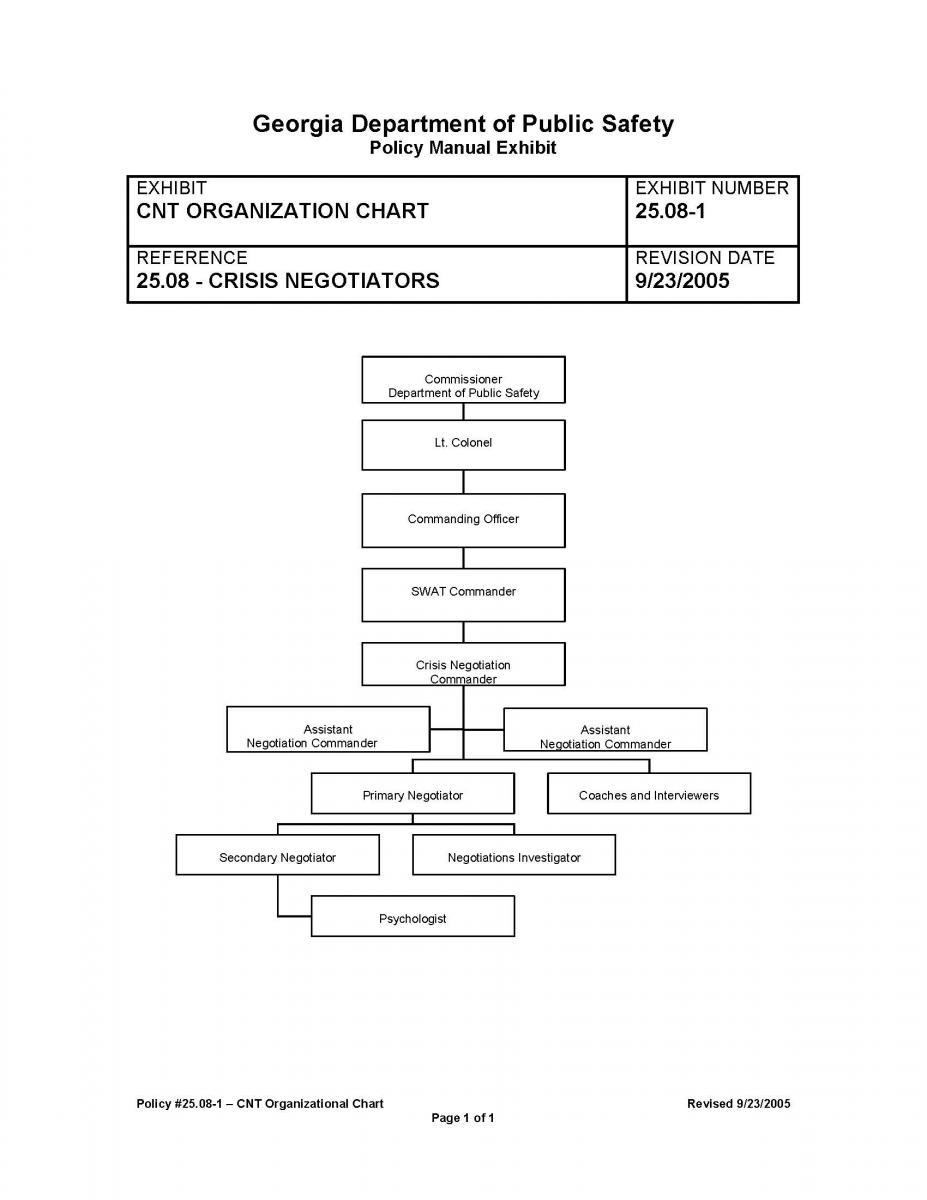
25.09 Capitol Police Division
DISTRIBUTION - ALL EMPLOYEES
DATE REVISED - 2/5/2018
POLICY REVIEWED - 2/5/2018
25.09.1 Purpose
To establish a policy and subsequent procedure regarding law enforcement and security services within the jurisdiction of the Capitol Police Division.
25.09.2 Mission
The mission of the Capitol Police Division is to provide professional law enforcement and security services to protect the public, state employees and visitors to the Capitol Square area.
25.09.3 Policy
It is the policy of the Capitol Police Division of the Georgia Department of Public Safety to deliver effective, efficient law enforcement and facilities security services to the State Capitol and other state owned buildings and properties in the Capitol Square area.
25.09.4 Definitions
A. Capitol Square
1. The property owned by the State and the sidewalks and streets within the area in the City of Atlanta bounded by Washington Street, Trinity Avenue, Memorial Drive, Capitol Avenue, Jessie Hill, Jr. Drive, Martin Luther King, Jr. Drive; and
2. The buildings and property owned and operated by the Georgia Building Authority which are located on or bounded by Central Avenue, Trinity Avenue, Memorial Drive, Capitol Avenue, Jessie Hill, Jr. Drive, Martin Luther King, Jr. Drive, Peachtree Street and Marietta Street.
25.09.5 Organization
A. The Capitol Police Division consists of three units.
1. Post 50 Capitol Hill
Post 50 Capitol Hill shall be staffed by Georgia State Patrol (GSP) troopers who have been carefully screened and selected for the positions in accordance with DPS Policy #24.01, Promotions and Transfers.
2. Capitol Police Services Unit
The Capitol Police Services Unit shall be staffed by sworn law enforcement officers.
3. Capitol Square Security Unit
The Capitol Square Security Unit shall be staffed by non-sworn Security Safety Officers and GSP Cadet Troopers.
B. The Director of the Capitol Police Division shall be appointed, without competitive examination, by the Commissioner of the Georgia Department of Public Safety from the ranks of the Georgia State Patrol.
The Director shall hold the rank designated by the Commissioner and will be responsible for the operations of the Division.
25.09.6 Procedures
The Capitol Police Division has the jurisdiction to enforce all laws in Capitol Square and the property and buildings owned by the Georgia Building Authority within a five-mile radius of Capitol Square. The Division’s duties include maintaining peace and order, enforcing criminal and traffic laws and regulations related to controlling access to Capitol Square, enforcing parking and traffic laws and investigating accidents within Capitol Square, enforcing state law when ordered to do so by the Commissioner and exercising law enforcement powers to protect life and property.
A. Post 50 Capitol Hill shall provide the full range of law enforcement and security services to the State Capitol, as well as other State owned buildings and properties in the Capitol Hill area including but not limited to:
1. Control and access to the State Capitol, as well as other State owned Buildings as designated;
2. Screening or searching packages entering those spaces for dangerous instruments;
3. Monitoring groups and individuals entering the spaces for dangerous or threatening behavior, and
4. Monitoring groups and individuals participating in special activities in and around the State Capitol, i.e. press conferences, rallies, demonstrations, etc. and;
5. Conducting area patrols in the buildings and on grounds to create a safe and secure environment for members of the public and state employees who work and/or visit the State Capitol area.
6. Conducting bomb sweeps and detecting suspicious packages with EOD K-9 teams.
B. The Capitol Police Services Unit shall provide the full range of police services in the Capitol Hill area including but not limited to:
1. Responding and investigating traffic crashes and the management of related traffic issues;
2. Respond to criminal complaints;
3. Securing and stabilizing crime scenes;
4. Conducting criminal investigations;
5. Management of vehicular and pedestrian traffic;
6. Referring major criminal investigations to the Georgia Bureau of Investigation and assist that agency as requested;
7. Coordinating police and security services and criminal or security intelligence for special events in the Capitol Hill area, and
8. Monitoring groups and individuals participating in special activities in and around the State Capitol, i.e. press conferences, rallies, demonstrations, etc.
9. Conducting bomb sweeps and detecting suspicious packages with EOD K-9 teams.
C. The Capitol Square Security Unit shall provide a full range of facility security and safety services including but not limited to:
1. Controlling and monitoring access to the Capitol and various executive center offices to detect and identify dangerous devices, persons or groups, and behaviors;
2. Screening or searching packages entering those spaces for dangerous instruments;
3. Monitoring groups and individuals entering the spaces for dangerous or threatening behavior;
4. Providing immediate notice to Troopers and Police Officers of dangerous persons, instruments, or behaviors, and
5. Providing timely notice of facility safety issues (e.g., broken or damaged doors, windows, stairs, fire extinguishers, elevators, etc.).
25.10 Child Abduction Response Team (C.A.R.T.)
DISTRIBUTION - SWORN EMPLOYEES
DATE REVISED - 4/20/2018
POLICY REVIEWED - 4/20/2018
25.10.1 Purpose
The Child Abduction Response Team (C.A.R.T.) was created by an executive order signed by the Governor to provide an immediate and efficient response to missing, abducted, or endangered children in the State of Georgia. It is comprised of nine different state agencies, utilizing their resources and both sworn and non-sworn staff:
Georgia Bureau of Investigation
State Board of Pardons & Paroles
Georgia Department of Public Safety
Georgia Department of Juvenile Justice
Georgia Department of Natural Resources
Georgia Department of Corrections
Georgia Department of Human Services
Georgia Department of Transportation
Georgia Emergency Management Agency
25.10.2 Policy
It is the policy of the Georgia Department of Public Safety to immediately and efficiently respond to a child abduction or otherwise missing or endangered child alert.
25.10.3 Procedures
A. The activation criteria for C.A.R.T. are as follows:
1. The true (non-family) abduction of a minor child (under the age of 18); or
2. The abduction of a minor child (under the age of 18) with endangerment circumstances. These circumstances must clearly be articulated to the C.A.R.T. Coordinator in order to activate the team members. The child’s disappearance or abduction shall meet the endangerment criteria if the child’s life or well-being is perceived to be at-risk (due to violence or health conditions), or if the identified parental abductor has a potential for violence and could endanger the child, or
3. Any other abduction or missing child investigation that requires immediate response in order to protect the well-being of the child. All incidents at this level shall require the approval of the Georgia Bureau of Investigation.
B. Upon the request from the local law enforcement agency with jurisdiction over the incident, confirmation that the activation criteria has been met and the C.A.R.T. response is necessary, GBI communication center will activate C.A.R.T. by notifying the nine C.A.R.T. liaisons.
C. Upon C.A.R.T. activation, the DPS Liaison to C.A.R.T. will:
1. Notify the Troop/Region Commander in the affected area for law enforcement support. DPS members assigned by the Troop/Region Commander shall respond immediately and arrive at the designated location as soon as possible.
2. Respond to the designated command post to coordinate DPS efforts, which may include providing:
a. DPS sworn members for a Community Canvass;
b. DPS sworn members for concentrated patrol on known areas of the missing child for recovery of suspect/vehicles:
c. DPS members for Road Checks to:
1) Search all vehicles for missing child or for clues/evidence related to the abduction; and
2) Identity potential suspects entering or leaving the area. Information gathered will be documented on the Roadblock Canvass Form and submitted to GBI for analysis.
d. DPS sworn members for security at the residence of the missing child or other locations, as needed;
e. Communications assistance for the abduction response. If needed, the DPS Interoperability Coordinator shall provide a mobile communications trailer to the designated C.A.R.T. Command Post. The DPS Interoperability Coordinator will act as the communications leader to the C.A.R.T. Liaisons to achieve a workable communications line among all nine agencies;
f. Aviation support, and
g. SWAT or Dive Team support.
D. The Commissioner of the Department of Public Safety shall designate the Department’s Liaison to C.A.R.T. and the Interoperability Coordinator.